The Burst Detection of Ghaemmaghami
By Nicolas Sacchetti
On May 15, 2024, Ali Ghaemmaghami, PhD student at the Concordia Institute for Information Systems Engineering presented this Anchor POINT exploring burst detection methods, machine learning techniques, deep learning approaches and how they can be applied to predict and recognized emerging technologies at an early stage.
At the outset of his presentation, Ghaemmaghami introduces two academic citations that underpin his research on emerging technologies:
- Emerging technologies have the potential to change technological paradigms and existing socio-economic structures. (Day and Schoemaker, 2000; Zhou et al., 2019)
- Emerging technologies have five attributes: radical novelty, relatively fast growth, coherence, prominent impact, and uncertainty and ambiguity. (Rotolo et al., 2015)
Then to emphasize the importance of his research Ghaemmaghami gives us citations of academics who underline the role of this early detection, and gives a graphic showing the rapid growth about this topic:
- Early detection of emerging technologies empowers R&D and policy-making with knowledge, intelligence, and opportunities. (Jang et al., 2021; S. Xu et al., 2021)
- The rapid pace of technological change makes fast detection of emerging technologies increasingly valuable for leveraging big data. (Zamani et al., 2022)
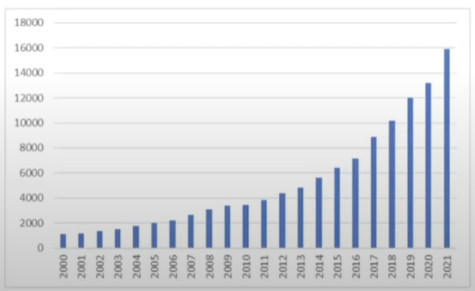
This graphic represents the trend of the documents with the topic of emerging technologies in the WOS database.
The Web of Science database (WOS) is a comprehensive academic citation index. It provides access to a vast collection of research literature across various disciplines, including science, social sciences, arts, and humanities. It indexes and abstracts millions of scholarly articles from thousands of journals, conference proceedings, and other sources, making it a valuable tool for researchers, scientists, and academics to discover and track scholarly publications, citations, and trends in research.
Identification Methods of Emerging Technologies
- Lexical-based approaches
- Bibliometric-based approaches
- Indicator-based approaches
- Machine learning approaches
- Hybrid approaches
Those approaches may have overlaps between themselves says Ghaemmaghami.
Lexical-based approaches
The data scientist explains that lexical-based approaches focus on analyzing term-related information to identify key terms and trends using methods such as co-word and keyword analysis. He cites four authors that he qualifies as main researchers on lexical-based approaches:
Bibliometric-based approaches
« As for bibliometric-based approaches, they are used for analyzing scientific literature to identify patterns and trends in research and development areas. Examples include citation analysis, co-citation, and social network analysis, » says Ghaemmaghami. He then presents some of the work that has been done on the subject:
Indicator-based approaches
The indicator-based approaches focus on using various metrics. He explains that they detect patterns and trends in research and development by analyzing metrics such as the number of publications, patents, and specific keyword frequencies to identify emerging technologies. Here is the work on the subject that he presents:
Machine learning approaches
Machine learning approaches usually automate the detection and analysis process to enable predictive modeling and techniques like data mining and natural language processing. Ghaemmaghami also emphasizes that these are powerful methods with their limitations:
Hybrid approaches
Leveraging the strengths and mitigating the weaknesses of individual methods, hybrid approaches combine different techniques as mentioned above to identify emerging technologies. Ghaemmaghami presents these:
Limitation in the existing emergence detection methods
« We should acknowledge that these methods still have their own limitations, » says Ghaemmaghami. Among these limitations is the risk of subjectivity due to manual interventions. He adds that many of these approaches heavily rely on manual data entry, which can introduce errors and biases, and is both time-consuming and labor-intensive. Furthermore, he points out the limited scalability of many of these methods: « so they cannot be used when we are dealing with high volumes of data. »
Ghaemmaghami also highlights that many of these approaches lack quantifiable metrics to measure the performance of the emerging technology detection process. Even when such metrics exist, they may suffer from a lack of predictability or low accuracy rates for future predictions. Additionally, these methods often struggle to accommodate various data types, being limited to sources such as patents or papers in the emergence detection process.
Burst Detection and Emergence
Burst detection identifies sudden intense increases in activity or interest in specific subjects, indicating emerging trends or topics. « Because of these limitations, we are going to mix and use the burst detection process and add it to the emergence detection process, » explains Ghaemmaghami.
He continues, saying that this idea of burst detection was first introduces by Kleinberg (2002). Then, the project of using burst detection in the emergence technology detection process happened almost ten years later when Guo et al. (2011) used it in their mixed-indicators model « to describe and predict key structural and dynamic features of emerging research areas. »
Giving more references, Ghaemmaghami mentions that the burst detection process was developed over the years using Kleinberg’s method in different applications, including Twitter and news feeds: Diao et al. (2012); Fung et al., (2005); Berger (2014).
« Nowadays, we have seen after the Kleinberg’s work that these methods have been teak and improved by, for example, proposing a new burst detection method based on stock market analysis more suitable for scientific documents: Topic Dynamics, He and Parker (2010), » says Ghaemmaghami.
Then he explains that the Topic Dynamics method has been tweaked and applied to predict the future computer science topics: Tattershall et al. (2020).
Prediction of Sustaining Emerging Technology Terms Using Burst Detection and Deep Learning (Ghaemmaghami, 2023)
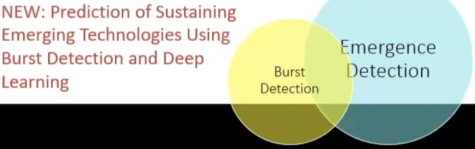
« We are going to add the idea of burst detection to the idea of emergence and predict the sustaining emergence technologies using burst detection and deep learning, » says Ghaemmaghami.
Ghaemmaghami’s research focus on two data types, patent (database: lens.org) and paper (database: dplb.org), with the search query AI terms: « artificial intelligence » or « deep learning » or « machine learning » to be found in the titles or abstracts of patents or papers.
This content has been updated on 2026-03-12 at 13 h 29 min.